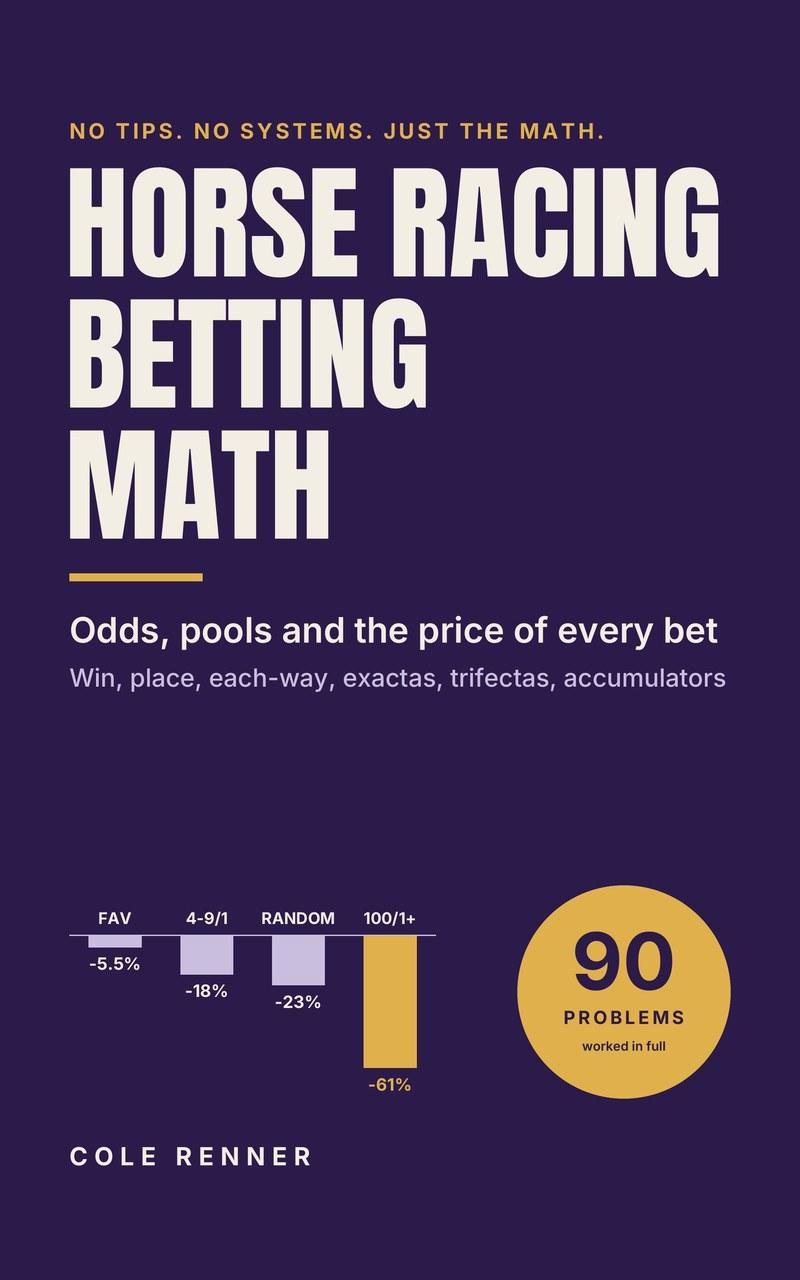
I spent six years across the room from a race book. Here is the arithmetic the tote board and the betting shop don't show you.
Every price at the track is a probability with a cut taken out. Horse Racing Betting Math shows how big the cut is, where it hides, and what each bet really costs, for the American pools and British fixed odds alike, with every sum worked out so you can check it.
Coming soon to Amazon, in paperback and Kindle
What's inside
- Fractional, decimal and American odds, and how to turn any price into a chance
- The book on a race, the pari mutuel pool, the tote takeout, breakage and payouts
- Win, place, show and each way betting, with the UK place terms that change the value
- Exactas, trifectas, superfecta boxes, pick 4 and pick 6 carryovers, the Yankee and Lucky 15
- The favorite-longshot bias, measured on 6.4 million US starts
- Handicapping: speed figures, form, making your own odds line, and value betting
- Dutching, the Kelly criterion, bankroll sizing, Rule 4 and dead heats
- 18 charts and 90 practice problems with worked answers
From the Long Run Price List
What a $100 bet costs on average, worked out in this book.
Contents
- 1.Every Price Is a Probability
- 2.The Book on a Race
- 3.The Pool
- 4.Fixed Odds or the Pool?
- 5.Win, Place and Show
- 6.Each-Way
- 7.Exactas, Trifectas and Superfectas
- 8.Pick 4s, Pick 6s and the Jackpot
- 9.Doubles, Trebles and the Yankee
- 10.Your Own Price
- 11.The Favorite-Longshot Bias
- 12.Speed, Class and Form
- 13.Dutching and Savers
- 14.Longshots and Losing Runs
- 15.How Many Bets Before You Know
- 16.How Much to Bet
- 17.Non-Runners, Dead Heats and the Small Print
- 18.One Day at the Races
156 pages, 6 x 9 paperback and Kindle. 18 charts.
Questions readers ask
- Is this a horse racing betting system?
- No system and no tips. It shows the price of every bet, where the cost falls, and what it would take to beat it.
- Is it current with how racing is bet?
- Yes. It covers the pools and fixed odds you'll meet: tote takeout, the starting price, exchange commission, each way terms and full-cover bets.
- Does it cover UK betting as well as US?
- Yes. Each way, Rule 4, the starting price, forecasts, tricasts, the Placepot and the Yankee sit beside win, place, show and exotics.
- Is it good for beginners?
- Yes. It starts from what a price means, explains every term, and every chapter ends with practice problems.
- When is an each way bet good value?
- The place terms decide. In one example the same horse's place part ran from minus 38% in a 7-runner race to plus 10% in a 16-runner handicap.
- Do longshots pay more in the long run?
- Less. In 6.4 million US starts, favorites lost about 5.5 cents per dollar and 100 to 1 shots about 61.
- How much should I bet?
- The book explains the Kelly criterion with a worked example and an exact run of 500 bets at three stake sizes, why most serious bettors use a fraction of it, and why a bettor without an edge should keep stakes small.
- How long before a betting record means anything?
- Longer than most think: after 1,000 bets at 10 to 1, the margin of error is still about 20 points either way.
- How is it different from other horse racing betting books?
- Most books sell a method or a tip sheet. This one prices the bets themselves, so you can judge any method, including your own, against the arithmetic.
- What do exactas and trifectas really cost?
- A five-horse trifecta box is 60 tickets, and every ticket pays the pool's cut. The book shows how to count tickets and estimate how often a box comes in.
- Who is the author?
- Cole Renner dealt cards in Nevada casinos, then spent six years in a sportsbook's back office with the race book across the room. He has no tips to sell.
- What goes with it?
- It pairs with Sports Betting Math and Gambling Systems That Actually Work, from the same publisher.