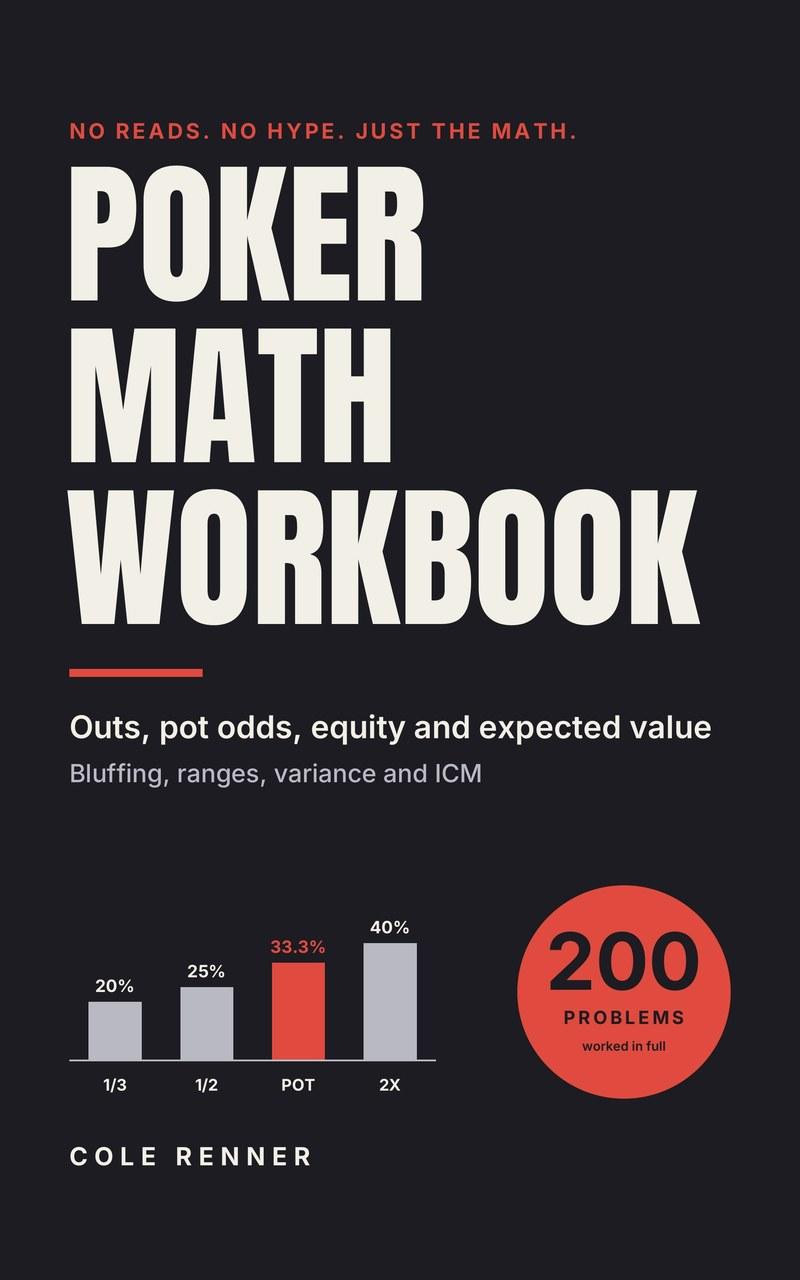
Poker is the one casino game where the arithmetic is between the players. This workbook teaches yours, then makes you do it: 200 practice problems, every answer worked step by step.
Most poker books explain the math once and move on. Poker Math Workbook gives each idea a short lesson, a chart and 10 problems, so pot odds, outs and expected value become habits you can use at the table, not pages you skimmed.
Coming soon to Amazon, in paperback and Kindle
What's inside
- Starting hands and flop odds, with all 19,600 flops counted
- Counting outs, and the rule of 2 and 4 against the exact numbers: a quick odds cheat sheet
- Pot odds, implied odds and the expected value of every call
- Preflop and flop equity: eight classic all-ins with every board counted
- Bluffing, fold equity, semi-bluffs, minimum defense and bluff-to-value ratios: the arithmetic underneath game theory optimal play, with no solver charts
- Hand reading with combos and blockers
- Win rate, variance, downswings, bankroll management and tournament ICM
- 16 charts and 200 practice problems with worked answers
Contents
- 1.Starting Hands
- 2.The Flop
- 3.Counting Outs
- 4.The Rule of 2 and 4
- 5.Pot Odds
- 6.Implied Odds
- 7.Preflop Equity
- 8.Equity on the Flop
- 9.The Expected Value of a Call
- 10.Bluffing
- 11.Semi-Bluffs
- 12.Defending and Balancing
- 13.Combos and Blockers
- 14.Win Rate and Variance
- 15.Bankroll and Downswings
- 16.Tournaments and ICM
146 pages, 6 x 9 paperback and Kindle. 16 charts.
Questions readers ask
- Is this a poker strategy book for beginners?
- Yes. It starts with counting cards and outs and builds, a chapter at a time, to bluffing, ranges and tournaments. Every sum is simple arithmetic, and each one is worked step by step in the answers at the back. You need a calculator and patience, nothing else.
- Does it cover no limit Holdem (NLHE)?
- Yes. The examples are no limit Texas Holdem, and most of the arithmetic carries straight over to other games.
- Is it current with how poker is played?
- Yes. It covers bet sizing, minimum defense frequency and balanced bluffing, the ideas behind game theory optimal (GTO) play, explained as arithmetic.
- How many practice problems are there?
- 200: ten after every chapter and 40 mixed problems at the end, all with full worked answers.
- What equity does a call need?
- 25% against a half-pot bet and 33.3% against a pot-sized bet. The book shows the formula and when implied odds change it.
- Are the equities exact?
- Yes. Preflop matchups count all 1,712,304 boards; flop spots count every turn and river.
- Does it help with hand reading?
- Yes. A chapter on combos and blockers shows how to count an opponent's range, so "they might have it" becomes a number: on a K-7-2 board, sets are 9 combinations and A-K is 12.
- What about bankroll management and variance?
- It shows how often a winning player is still behind after 10,000 hands, how deep downswings get, how big a bankroll keeps the risk of ruin small, and how tournament ICM changes the value of chips near the prizes.
- How often does a flush draw come in?
- From the flop, 34.97% by the river; on the turn alone, 19.57%. The rule of 4 says 36% and 18%. The book has the exact chance for every number of outs from 1 to 20.
- How often must a bluff work?
- A half-pot bluff needs folds one time in three; a pot-sized bluff, one time in two. A semi-bluff with a real draw needs far fewer, because it can still win when called.
- Who is the author?
- Cole Renner dealt cards in Nevada casinos and set sportsbook lines. He plays small-stakes poker with friends and has no system to sell.
- What goes with it?
- It pairs with Sports Betting Math and Blackjack Math, from the same publisher.